



Imagine you’ve finally finished your estate plan, but your primary trustee is in a hospital bed and another is across town. The technicality of a single signature shouldn’t be the thing that keeps you awake at night. It’s common to feel overwhelmed when coordinating the final steps of your legacy. You want to ensure every document is legally binding, yet managing schedules and travel for multiple signers often feels like an impossible puzzle. Getting a trust notarization Sacramento requires precision and a clear understanding of current California laws to avoid the risk of document rejection.
You deserve a signing experience that’s as steady and reliable as the trust you’ve built. This guide explains how to properly notarize your living trust and estate documents with a professional mobile service that meets you at your convenience. We’ll walk through the 2026 identification requirements, the logistics of hospital bedside signings, and how to ensure your documents meet all state standards. By the end of this article, you’ll have a clear roadmap for securing your family’s future from the comfort of your own home or a care facility.
Key Takeaways
- Understand why trust notarization Sacramento is essential to prevent fraud and ensure your estate plan is fully enforceable under the California Probate Code.
- Learn how to audit your documents for missing pages and coordinate your trustees to ensure a smooth, error-free signing session.
- Discover the privacy advantages of using a mobile notary service that travels to your home or office instead of visiting a public retail location.
- Verify the specific identity requirements and state-approved verification methods needed for all trustees and witnesses before your appointment begins.
- Find out how specialized bedside services assist families who need to manage urgent trust documents within Sacramento hospitals or nursing home environments.
Understanding Trust Notarization in Sacramento
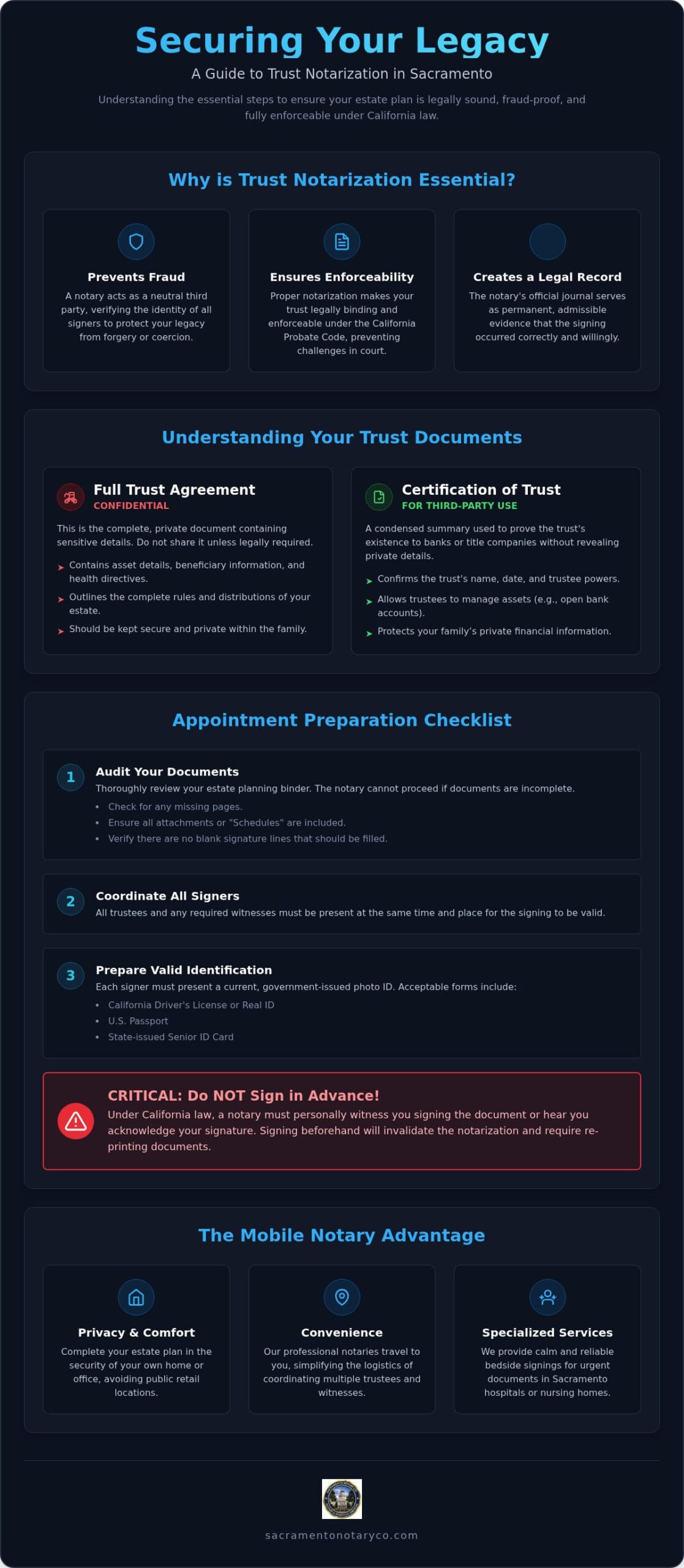
Trust notarization Sacramento is the formal process where a commissioned official verifies that the people signing your estate documents are who they say they are. This step is vital because it protects your legacy from fraud. If a signature is forged or coerced, the entire document could be challenged in court. Proper notarization ensures your trust remains enforceable under the California Probate Code. A notary public acts as a neutral party. They confirm your identity, check for signs of duress, and ensure you’re signing of your own free will. This verification creates a layer of security that protects both the trustees and the beneficiaries.
Most estate plans aren’t just a single document. They’re a bundle of legal papers that work together to manage your assets. Common documents that require this level of verification include:
- Revocable Living Trusts: The core document that outlines how your assets are managed.
- Trust Amendments: Legal updates to your existing trust that must be notarized to be valid.
- Certifications of Trust: A summary used to interact with financial institutions.
- Pour-over Wills: A backup document that ensures any forgotten assets are moved into your trust.
The Difference Between a Trust Agreement and a Trust Certification
A full Trust Agreement contains sensitive details about your assets, your health directives, and your beneficiaries. You likely want to keep this information private. If a bank or title company needs proof of your trust’s existence, you don’t have to show them the entire document. Instead, you can provide a Certification of Trust. A Certification of Trust is a condensed version of the main document for third-party use. It provides only the necessary facts, like the date the trust was formed and the specific powers granted to the trustees. This keeps your family’s private distributions confidential while still allowing you to open accounts or transfer property. If you’re also managing corporate assets, we provide specialized business contract notary Sacramento services to keep your professional and personal affairs in order.
California Requirements for Valid Trust Notarization
California has strict rules for estate planning documents. Every notary must record the signing in an official Notary Journal. This entry includes the date, time, and the specific type of identification used to verify the signer. If a legal dispute arises years later, this journal serves as a permanent, admissible record of the event. It’s a protection for your family that proves the signing happened correctly.
The notary must also use specific statutory wording in the certificate of acknowledgment. If the wording is incorrect or outdated, the document might be rejected by the county recorder or a financial institution. This rejection often happens at the worst possible time, such as during a real estate closing or a medical emergency. In some cases, your specific trust structure might require additional disinterested witnesses to sign alongside the notary. We help you identify these requirements ahead of time so your appointment is successful on the first try.
Preparing Your Documents and Signers for the Appointment
Success during a trust notarization Sacramento appointment starts before the notary rings your doorbell. You must perform a thorough audit of your estate planning binder. Check for missing pages, blank signature lines, and ensure all attachments or “Schedules” of assets are included. If a page is missing, the notary cannot proceed with the signing. Coordinating schedules is equally vital. All trustees and any required witnesses must be present at the same time to ensure the process moves efficiently. This prevents the need for multiple return visits and keeps your legal fees manageable.
The most common error is signing the document before the notary arrives. According to the California Secretary of State, a notary must personally witness the signing or hear the signer acknowledge the signature. If you sign ahead of time, you’ll likely need to print a fresh copy and start over. To avoid these delays, you can review our professional mobile notary Sacramento checklist to ensure your home is ready for the visit.
California Identification Standards for Trustees
Every signer must present a valid, government-issued photo ID. Acceptable forms include a current California Driver’s License, a US Passport, or a Senior ID card. The name on the identification must match the name drafted in the trust documents. If there’s a significant discrepancy, like a missing middle name or a hyphenated last name not present on the ID, the notarization may be delayed while we verify the legal requirements.
Sometimes a loved one, particularly a senior in a care facility, may have an expired ID or no ID at all. In these specific cases, we use the “Credible Witness” procedure. This involves two individuals who personally know the signer and have valid IDs of their own. They must swear under oath to the signer’s identity in the presence of the notary. This solution ensures that legal documents remain accessible even when traditional identification is unavailable. If you’re unsure about your ID status, contact us to discuss your options before the appointment.
Setting Up a Quiet and Productive Signing Space
Trust binders are often thick and complex. You’ll need a large, well-lit table where the notary can spread out the documents and the official journal. Good lighting is essential for the notary to verify fine print and for the signers to read what they are signing. Remove distractions like loud televisions or pets to maintain a professional atmosphere. This focus helps prevent errors on high-stakes documents.
We frequently handle signings for clients with limited mobility or vision. If a signer cannot hold a pen or has trouble seeing the signature line, let us know in advance. We’ll adjust the pace of the appointment to ensure they are comfortable and fully aware of the proceedings. Taking these small steps helps create a calm environment for everyone involved, ensuring the “willingness and awareness” of the signer is properly documented.
The Benefits of Mobile Notary for Sacramento Families
Mobile notary services offer a level of personalization that traditional office visits can’t match. When you’re managing a trust notarization Sacramento, the primary benefit is convenience. We travel to your home, office, or even a local coffee shop. This flexibility allows you to schedule appointments during evenings or weekends. This is essential for families with busy professional lives or situations where multiple trustees must coordinate their arrival from different parts of the county. If your schedule changes, a mobile specialist can often adapt more quickly than a traditional storefront.
Privacy is another significant factor. Discussing your assets, inheritance plans, or family dynamics in a public setting is often uncomfortable. A mobile service allows these sensitive conversations to happen in the safety of your own living room. While California law on creating a trust defines the foundational requirements for these legal entities, notarization provides the practical security needed for property transfers. Our expertise includes deed notarization Sacramento, which ensures your real estate is correctly moved into your trust without the technical errors that often lead to recording delays.
Mobile Notary vs. Retail Stores (UPS/FedEx)
Retail stores like UPS or FedEx often provide notary services, but they are rarely equipped for complex estate planning. These environments are usually rushed, noisy, and lack the privacy required for legal signatures. Because trust documents are multi-page and technically demanding, many retail employees will refuse to notarize them to avoid corporate liability. They may not have the specialized training required to handle trust binders or the patience to verify multiple signers. In contrast, a mobile professional provides focused, one-on-one attention. If a loved one is currently in a care facility, a retail store isn’t an option. We provide upfront information on hospital notary fees Sacramento so you can arrange for bedside signings with full financial transparency.
Bedside Trust Notarizations in Sacramento Hospitals
We regularly navigate major local facilities such as UC Davis Health, Sutter Medical Center, and Kaiser Permanente. These signings require careful coordination. We work with you to ensure the patient is alert, aware, and capable of signing before the appointment begins. It’s helpful to speak with the nursing staff to identify a quiet window between medical rounds. We also handle medical directives and powers of attorney alongside the trust. This comprehensive approach ensures all your urgent documents are completed in a single visit, reducing stress for the patient and the family during a difficult time.
Step-by-Step: The Trust Notarization Process
The process for trust notarization Sacramento follows a methodical sequence to ensure every legal requirement is met. First, we’ll schedule your mobile appointment and confirm the specific types of documents you need verified. This preparation ensures we bring the correct notary certificates and allocate enough time for all signers to review their work. Once we arrive at your location, the verification stage begins. We carefully check the government-issued identification of every trustee and witness to confirm they match the names listed in your estate plan exactly.
Next, we conduct a brief, professional interaction with each signer. This isn’t a legal interrogation; it’s a procedural check to ensure everyone understands the document and is signing freely without outside pressure. We look for signs of awareness and willingness, which are essential for a valid notarization. Once the notary is satisfied, the signatures are executed in the official journal and on the documents. Finally, we complete the required journal entries and apply the official notary seal to your trust papers.
The California Notary Journal and Thumbprint Requirement
California law requires a higher level of scrutiny for documents that affect real property. If your trust includes a deed to transfer a home or land, the notary must obtain a thumbprint from each signer in their official journal. We use a high-quality, inkless pad that leaves no messy residue on your skin. We maintain the security and privacy of your personal information by keeping our journals under lock and key, accessible only to the notary or law enforcement if legally required. The thumbprint is a statutory anti-fraud measure for Sacramento property transfers.
After the Signing: Organizing Your Notarized Documents
After the signing is complete, you should store your original trust documents in a secure location, such as a fireproof safe or with your estate attorney. It’s also wise to make high-quality digital scans and physical copies for your trustees or financial institutions. Most banks will require a copy of the notarized Certification of Trust to update your accounts. If your trust involves international assets or business interests, you might need a business document apostille Sacramento to ensure your documents are recognized by foreign governments. If you’re ready to finalize your estate plan with a professional touch, book your trust notarization appointment today.
Sacramento Notary Co: Calm and Reliable Trust Services
Sacramento Notary Co serves the entire Sacramento metro area, including Elk Grove, Roseville, and Folsom. Our team understands that estate planning often happens during high-stakes or emotionally charged moments. We’ve built our reputation on a commitment to punctuality and procedural accuracy for every Sacramento family. When you book a trust notarization Sacramento, you aren’t just hiring a signature verifier. You’re partnering with a prepared expert who ensures your legal documents meet all state standards without the stress of travel or logistical errors.
We take a problem-solver approach to every appointment. If your situation involves complex corporate structures or professional assets, we can help. Our specialized expertise in business contract notary Sacramento ensures that your personal legacy and professional compliance are both protected. By handling the administrative heavy lifting, we allow you to focus on what matters most: your family and your peace of mind.
Why Our Clients Choose Mobile Excellence
Many of our clients come to us through referrals from estate planners and law firms. These professionals value our ability to handle high-volume signings with precision. Our local specialists have a deep understanding of Sacramento County recording requirements, which prevents the technical rejections that often delay property transfers. Families frequently highlight our calm demeanor during signings in sensitive environments, such as nursing homes or hospitals. We maintain a steady, matter-of-fact delivery that lowers the stress levels for everyone in the room.
Book Your Trust Notarization Appointment Today
If you have an urgent need, we provide emergency estate planning services to ensure your documents are executed when time is of the essence. You can get an immediate quote for our mobile services by contacting us with your location and the number of signatures required. We’re available to assist you with 24/7 availability for emergency estate planning needs, providing a reliable solution whenever a crisis arises. Don’t leave your legacy to chance or let technical errors invalidate your hard work. Schedule your professional trust notarization with Sacramento Notary Co today.
Securing Your Family’s Future with Confidence
Finalizing an estate plan is a significant milestone that requires procedural accuracy. You’ve learned how to audit your documents for completeness, verify identification requirements, and coordinate trustees to ensure a smooth signing experience. These steps are vital for creating a legally binding document that stands up to scrutiny. Choosing a professional for your trust notarization Sacramento ensures that your legal intent is backed by a binding, fraud-resistant signature recorded in an official journal.
We’re here to function as your steady guide during these high-stakes moments. Whether you require a quiet signing in your home or specialized hospital bedside services, our team is prepared to handle the logistics. We bring expertise in estate planning and trusts to every appointment, serving the Greater Sacramento area 24/7 for emergency needs. You’ve done the hard work of building your legacy; let us handle the final verification with the care it deserves. Contact Sacramento Notary Co for Reliable Mobile Trust Notarization and take the final step toward protecting your family’s future today.
Frequently Asked Questions
Do all pages of a living trust need to be notarized?
No, typically only the signature pages require notarization. However, the entire document must be present during the appointment so the notary can verify the document’s complete and that the signature page is attached to the correct instrument. If pages are missing, the notary can’t proceed. This ensures the integrity of the trust and prevents unauthorized pages from being inserted later.
Can a notary help me write or explain the legal terms in my trust?
A notary public can’t provide legal advice or explain the effects of the terms within your trust. We’re strictly impartial witnesses who verify identities and the willingness of the signers. If you’ve questions about the language or legal consequences of your estate plan, you should consult with a qualified attorney before scheduling your appointment. Our role’s limited to procedural verification and administrative accuracy.
How much does it cost to notarize a trust in Sacramento?
California law sets the maximum fee for each signature at $15 through the end of 2026. This fee is scheduled to increase to $20 on January 1, 2027. For a trust notarization Sacramento, you should also account for a separate travel fee charged by the mobile notary. Travel fees aren’t regulated by the state and vary based on the distance and time required for the visit.
What happens if a trustee cannot physically sign the document?
If a trustee’s unable to sign due to a physical disability, California law allows for signature by mark in specific circumstances. This method requires two disinterested witnesses to be present during the signing to witness the mark and sign the document themselves. The notary will then perform the standard identification process for the signer. If you anticipate this need, please inform us in advance so we can prepare.
Does California require a thumbprint for trust notarization?
A thumbprint’s required if the trust document involves the transfer of real property. Since most living trusts include a deed to move a home or land into the trust, the notary must capture a thumbprint in their official journal. This is a mandatory anti-fraud measure. If your trust’s purely for personal property or cash assets, a thumbprint might not be legally required, but it remains a best practice.
Can you notarize a trust for a patient at UC Davis Health or Sutter Medical Center?
We provide specialized hospital bedside services at all major Sacramento medical facilities. We regularly visit patients at UC Davis Health, Sutter Medical Center, and Kaiser Permanente for a trust notarization Sacramento. We coordinate with family members to ensure the patient’s alert and has their identification ready. This service is designed to lower the stress of managing urgent estate documents during a medical crisis or recovery period.
How long does a typical mobile trust signing appointment take?
A standard appointment usually lasts between 30 and 60 minutes. The duration depends on the number of signers present and the complexity of the document binder. If multiple trustees are signing or if there are several deeds included, the process may take longer. We prioritize accuracy over speed to ensure every signature’s verified and every journal entry’s completed according to California state law.
Do I need witnesses for my trust notarization in California?
Witnesses aren’t always required for the trust document itself if it’s being notarized. However, companion documents often require them. Common documents needing two disinterested witnesses include:
- California Wills and Codicils
- Advance Healthcare Directives
- Uniform Statutory Powers of Attorney
If witnesses are needed, they must be present at the same time as the notary during the appointment.