



Imagine standing at the Sacramento County Recorder’s window after weeks of preparation, only to have your deed handed back because of a simple formatting error or an outdated notary certificate. It’s a common frustration for many local residents, but deed notarization Sacramento doesn’t have to be a source of anxiety. Whether you’re transferring a family home into a trust or finalizing a private sale, the process requires absolute procedural accuracy to be legally successful.
We understand that coordinating multiple signers and deciphering California specific notary wording can feel overwhelming, especially when the stakes involve your most valuable assets. You deserve a signing process that’s both legally sound and entirely stress free. This expert guide provides everything you need to ensure your property transfer is legally binding and ready for immediate recording. We will walk you through the current 2026 fee structures, the specific margin requirements for the County Recorder, and how a mobile service can simplify even the most complex multi-party signings. By following these verified steps, you can move forward with the confidence that your documentation is prepared to the highest professional standards.
Key Takeaways
- Understand why proper identity verification is the first line of defense against real estate fraud in California.
- Learn the critical differences between Grant Deeds and Quitclaim Deeds to choose the right document for your specific property transfer.
- Discover how a mobile service simplifies deed notarization Sacramento by bringing professional verification directly to your home or office.
- Get a step-by-step checklist of required identification and document formatting to ensure the Sacramento County Recorder accepts your filing.
- Verify that your documents meet current 2026 California notary requirements to avoid costly recording delays or legal rejections.
What is Deed Notarization and Why is it Essential in Sacramento?
At its core, deed notarization Sacramento is the formal process of verifying a signer’s identity on a property transfer document. A notary public acts as a state-commissioned, impartial witness who ensures that the person signing the deed is who they claim to be. This verification is the primary defense against real estate fraud. Without this step, anyone could theoretically sign your name to a document and attempt to seize your property. Before diving into the logistics, it’s helpful to understand What is a Property Deed? and how it functions as the legal instrument for transferring ownership.
The notarization process transforms a private agreement between two parties into a document that is eligible for public record. In Sacramento, the County Recorder’s office serves as the official archive for these transactions. However, they don’t simply accept every document that crosses their desk. They require a valid notary certificate to ensure the transfer was executed voluntarily and with proper identification. This official seal provides the “constructive notice” required to protect your ownership rights against future claims.
The Legal Necessity of a Notary Public
California Government Code sections 27287 and 1189 dictate strict requirements for property transfers. If your document doesn’t include the specific “California All-Purpose Acknowledgment” wording, the Sacramento County Recorder will reject it immediately. This specific verbiage is mandatory under state law to ensure consistency across all 58 counties. The notary seal doesn’t just authenticate your signature; it verifies the document’s readiness for the Secretary of State and various administrative bodies. It’s a procedural safeguard that confirms the signer appeared in person, was properly identified, and signed the document under their own free will.
Consequences of Improper Notarization
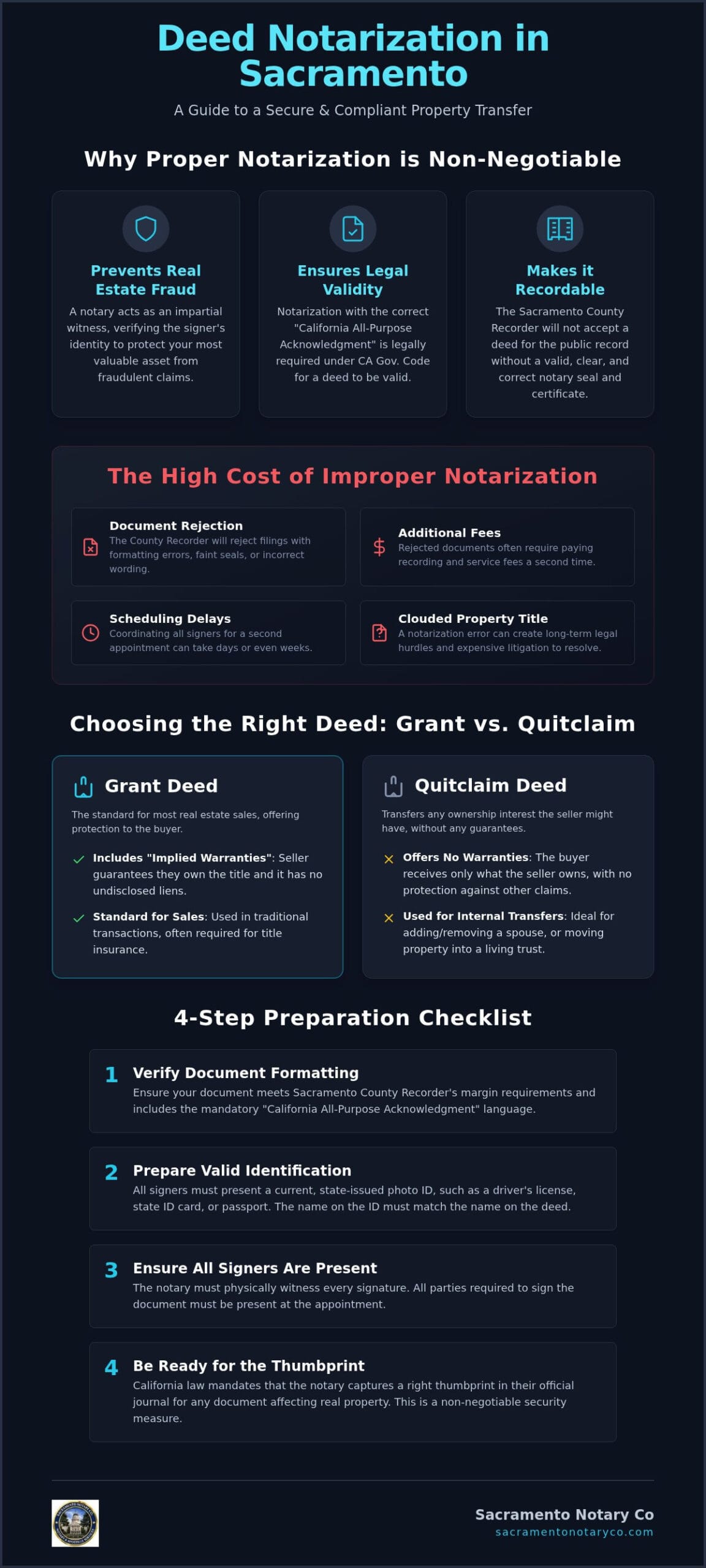
Document rejection is the most common consequence of poor notarization, and it’s an expensive mistake. The Sacramento County Recorder maintains strict formatting rules, including specific margin requirements and legible notary seals. If a seal is faint or overlaps with text, the document is often deemed unrecordable. This leads to a cascade of issues:
- Additional Fees: You’ll likely have to pay recording fees again once the document is corrected.
- Scheduling Delays: Coordinating a second meeting with all signers can take days or weeks.
- Lost Priority: In real estate, the order of recording matters; a delay could allow other liens to take precedence.
An error in notarization can cloud a property title for years, creating legal hurdles that often require expensive litigation to resolve.
Common Types of Property Deeds Requiring Notarization
Property transfers in Northern California rely on specific legal instruments to define ownership and liability. While the Sacramento County Recorder accepts various forms, the most common documents involve Grant Deeds, Quitclaim Deeds, and Interspousal Transfer Deeds. Each document carries different levels of protection for the buyer and seller, and choosing the wrong one can lead to significant title issues down the road. Because these documents represent a permanent change in property rights, the state mandates strict verification of all signatures.
Regardless of the deed type, the state requires a high level of security for real estate transactions. According to California notary law, the notary must capture a right thumbprint in their official journal for any deed notarization Sacramento. This requirement is a non-negotiable step designed to prevent identity theft and fraudulent property transfers in our local community.
Grant Deeds vs. Quitclaim Deeds
If you’re selling a home in a traditional real estate transaction, you’ll likely use a Grant Deed. This document includes “implied warranties,” meaning the seller guarantees they haven’t already sold the property to someone else and that there are no hidden encumbrances. It’s the standard for arm’s length sales where title insurance is involved.
Quitclaim Deeds are different because they offer no warranties at all. They’re most frequently used for internal family transfers, such as moving a property into a living trust or removing an ex-spouse’s name after a divorce. While they’re simpler to prepare, they still require the same rigorous identity verification. If you’re transferring property between family members, it’s often helpful to have a professional ensure the paperwork is executed correctly to avoid future disputes with the title company.
Deeds of Trust and Reconveyance
In Sacramento, mortgage-related transactions usually involve a Deed of Trust rather than a traditional mortgage. This three-party instrument secures the lender’s interest in the property. When you buy a home or refinance, you’ll likely work with a loan signing agent Sacramento to notarize these lengthy document packages. Once the loan is fully paid, a Full Reconveyance is recorded to clear the lender’s lien from your title.
Multi-party signings in estate settlements present unique challenges, especially when heirs are spread across different parts of the Sacramento metro area. A mobile notary can coordinate these complex signings by traveling to each party, ensuring that everyone’s identity is verified and the document is ready for the recorder’s office. This logistical support is vital for keeping probate or trust distributions on schedule. If you’re managing a complex estate, you can schedule your mobile notary appointment to ensure every signature is captured with professional accuracy.
Interspousal Transfer Deeds are another staple for local homeowners. These specialized documents are used to change property from community property to separate property, or vice versa. They’re common during refinances when a lender requires one spouse to “sign off” to meet specific loan criteria. Because these documents affect marital rights and tax assessments, the notarization must be handled with precise attention to detail.
Why Choose a Mobile Notary for Your Sacramento Property Transfer
Traditional retail settings often lack the privacy and specialized focus required for high-stakes real estate documentation. When you choose a mobile service for your deed notarization Sacramento, you eliminate the logistical burden of transporting sensitive paperwork across town. Instead of waiting in line at a noisy shipping store, you receive a dedicated appointment at your home, office, or even a hospital bedside. This personalized approach ensures that the notary can focus entirely on your specific document requirements without the distractions of a busy storefront.
The professional environment of a mobile appointment is particularly beneficial given the stringent requirements of state law. For example, California Government Code § 8206 requires that a notary public must obtain a right thumbprint in their journal for any document affecting real property. Managing these physical requirements, along with verifying identification for multiple parties, is significantly easier in a controlled, private setting. You can review the benefits of mobile notary Sacramento to see why this localized, in-person service remains the gold standard for property transfers compared to digital alternatives.
Convenience for Multi-Signer Deeds
Property transfers often involve multiple family members, heirs, or business partners who don’t always have synchronized schedules. Coordinating a trip to a physical office for three or four people is a logistical challenge that can delay your recording for weeks. Mobile notaries solve this by traveling to a central location that works for everyone, such as a family residence or a title company office. If parties are located in different parts of the Sacramento metro area, a mobile specialist can even facilitate “split signings,” where each party’s signature is notarized at different times or locations while maintaining document integrity.
Mobile Notary for Urgent Real Estate Deadlines
Real estate transactions move fast, and escrow companies often have rigid deadlines that don’t wait for a convenient opening at a bank. If a document is flagged for an error on the day of closing, you need immediate assistance to keep the deal alive. Access to emergency notary Sacramento services allows you to resolve these last-minute hurdles without leaving your home. Punctuality and preparedness are the hallmarks of a professional mobile service, providing a steady guide during the high-pressure moments of a property transfer. This level of responsiveness reduces the stress of meeting strict deadlines and ensures your deed is ready for the County Recorder exactly when it needs to be.
How to Prepare for Your Deed Notarization Appointment
Proper preparation is the key to a successful deed notarization Sacramento. Most recording delays happen because of simple oversights that could have been fixed in minutes. First, ensure the deed is fully filled out. Every blank space, aside from the signature and notary block, must be completed before the notary arrives. A notary cannot notarize a document that appears incomplete, as this creates a significant risk for fraudulent alterations after the seal is applied.
Second, leave the signature line blank. It’s a common mistake to sign the document in advance to save time. However, California law requires the signer to personally appear before the notary. If you’ve already signed the deed, you’ll likely be asked to sign it again in the notary’s presence to ensure the act is properly witnessed and acknowledged. This procedural step protects the integrity of your property transfer.
Acceptable Identification in California
Your identity must be verified using a form of identification that is current or issued within the last five years. In California, the standard acceptable documents include:
- A California Driver’s License or ID card
- A United States Passport
- A United States Military ID card
- An inmate ID card issued by the California Department of Corrections and Rehabilitation
If a signer lacks a valid ID, perhaps due to health issues or an expired license, California law allows for the use of “Credible Witnesses.” This process requires two people who personally know the signer, possess their own valid IDs, and can swear under oath to the signer’s identity. This is a vital option for hospital bedside signings or when working with elderly family members who no longer drive.
The Signing Environment and Witnesses
Creating the right environment helps prevent errors on your permanent public record. Choose a quiet, well-lit space, such as a dining table or office desk, where you can focus on the paperwork. While the notary acts as the official witness for the signature, some specific deeds or title companies may require additional “disinterested witnesses” to sign as well. It is always best to check with your escrow officer or attorney before the appointment to see if extra people need to be present.
The notary is also legally obligated to confirm that all signers are of sound mind and acting of their own free will. If a signer appears confused or under duress, the notary must stop the process to protect the signer’s rights. Taking a few minutes to ensure everyone is comfortable and prepared makes the entire process move at a brisk, professional clip. If you’re ready to secure your property transfer, you can book your mobile notary service today to ensure every detail is handled with procedural accuracy.
Professional Deed Signing Services with Sacramento Notary Co
Sacramento Notary Co functions as a steady guide for homeowners and professionals throughout the greater Sacramento metro area. We specialize in the high-stakes environment of property transfers, ensuring that every deed notarization Sacramento meets the rigorous standards of the County Recorder. Our commitment to procedural accuracy means we don’t just stamp a document; we verify that every California-specific requirement is satisfied before the signing concludes. Whether you’re in the middle of a complex probate settlement or a straightforward home sale, our goal is to make the administrative portion of the transfer as frictionless as possible. We serve clients across the entire region, including Sacramento, Folsom, Roseville, and the surrounding communities.
Expertise in Real Estate and Title Documents
Our team brings extensive experience working alongside title companies and escrow officers. We understand the urgency of a closing day and the precision required for documents that will become part of the permanent public record. Beyond property deeds, we frequently handle other complex legal instruments, such as a business contract notary Sacramento, providing a consistent level of professional oversight for our corporate and private clients alike. A property transfer is often more than just a transaction; it’s a significant life transition that requires a steady hand. Having a calm, reliable professional in the room helps lower the stress of the moment and ensures the logistical details are handled correctly the first time.
Simple Scheduling and Transparent Service
We prioritize professional transparency in every interaction. If you’re ready to schedule an appointment, we’ve designed our process to be straightforward and efficient. To provide an accurate quote and ensure we’re fully prepared for your signing, we’ll ask for a few specific details. This proactive dialogue helps us identify potential hurdles before we arrive at your door. Please be prepared to provide:
- The specific location for the appointment, whether it’s a home, office, or hospital.
- The type of deed being notarized, such as a Grant Deed or Quitclaim Deed.
- The total number of signers who will be present and require verification.
- Confirmation that all signers possess valid, unexpired identification as required by state law.
We promise punctuality and clear communication from the moment you reach out until the final seal is placed in our journal. If your situation changes or a document needs a last-minute update, we bring a problem-solver energy to the table to help you meet your recording deadlines. A seamless signing is the final step toward a successful property record.
Secure Your Property Transfer with Professional Accuracy
Successfully recording a deed in 2026 requires more than just a signature; it demands strict adherence to California’s evolving notary laws and the Sacramento County Recorder’s specific formatting standards. By selecting the correct deed type and ensuring your identification is current, you prevent the costly delays of document rejection. A mobile notary provides the logistical support needed to coordinate multi-party signings while maintaining the privacy and professional focus your real estate transaction deserves. We understand that these moments are high-stakes, and having a steady guide makes all the difference.
Whether you’re finalizing a home sale or moving assets into a trust, deed notarization Sacramento is the critical final step in protecting your property rights. Sacramento Notary Co offers Certified Loan Signing Agent expertise and calm, reliable document handling directly at your location. We travel throughout the Sacramento metropolitan area to ensure your paperwork is verified and ready for the public record. You’ve done the hard work of planning your property transfer; let us handle the final details with the precision and punctuality you expect.
Schedule Your Deed Notarization in Sacramento Now
Frequently Asked Questions
Can a notary help me choose which deed to use for my Sacramento property?
A notary public is prohibited by law from providing legal advice or choosing the document for you. Selecting a Grant Deed versus a Quitclaim Deed has significant legal and tax implications. If you’re unsure which form fits your situation, you should consult with a real estate attorney or a title professional. Our role is strictly limited to verifying the identity of the signers and ensuring the execution of the document is procedurally correct.
What is the current fee for deed notarization in Sacramento?
For most of 2026, the maximum fee a California notary can charge for a single signature is $15. This rate is set by state law and applies to acknowledgments and jurats. If you require a mobile service, there’s typically an additional travel fee which is not regulated by the state. It’s important to note that Assembly Bill 1597 will increase the maximum signature fee to $20 starting on January 1, 2027.
Do I need to go to the Sacramento County Recorder’s office to get my deed notarized?
You don’t need to visit the Sacramento County Recorder’s office for the notarization itself. The Recorder’s primary function is to archive and index documents after they’ve already been properly signed and notarized. Most residents find it much more efficient to complete their deed notarization Sacramento through a mobile service at their home or office. Once the document is notarized, you can then submit it to the Recorder in person or by mail.
What happens if the notary wording on my deed is from another state?
If your deed contains notary wording from another state, a California notary will likely need to attach a California-compliant acknowledgment certificate. The Sacramento County Recorder is known for rejecting documents that don’t use the exact statutory language required by the California Government Code. We always carry the correct “California All-Purpose Acknowledgment” forms to ensure your document meets local recording standards and avoids unnecessary rejection at the recording window.
Can a mobile notary come to a hospital in Sacramento to notarize a deed?
Yes, we frequently provide hospital bedside notarization for property deeds and other urgent legal documents. If a signer is hospitalized, we can travel directly to facility locations throughout the Sacramento metro area. We’re experienced in navigating these sensitive environments while maintaining the professional transparency required for a valid signing. Please ensure the signer is alert and possesses a valid form of identification before the notary arrives at the medical facility.
How long does a deed notarization appointment typically take?
A standard appointment for a single deed usually takes between 15 and 30 minutes. This timeframe allows us to verify the signer’s identification, record the required thumbprint in the notary journal, and complete the certificate. If you have multiple signers or a large package of loan documents, the process will naturally take longer. Being prepared with your unexpired ID and a fully completed document helps the appointment move at a brisk, professional clip.
Is a deed valid if it was notarized but not yet recorded?
A deed is generally considered valid between the parties involved once it’s signed, notarized, and delivered. However, failing to record the document with the Sacramento County Recorder leaves your ownership interest vulnerable to third-party claims or liens. Recording provides “constructive notice” to the public that you own the property. To ensure your deed notarization Sacramento leads to full legal protection, you should aim to record the document as soon as possible after the signing.
5 thoughts on “Deed Notarization Sacramento: The Complete 2026 Guide to Property Transfers”