



An improper notarization is a “hidden defect” that can dismantle your legal protections years after a signing occurs. You likely believe that once a seal is pressed onto the page, your contract or deed is ironclad. It’s a common assumption, but in California, a single missing thumbprint or an incorrect certificate can turn a vital document into a legal liability. If you’re feeling anxious about the validity of a power of attorney or a real estate deed, you aren’t alone. The consequences of improper notarization in California can range from frustrating delays in a hospital room to the total invalidation of a high-stakes contract.
This guide will help you understand the specific legal, financial, and personal risks associated with notary errors under 2026 standards. We’ll break down the civil penalties that can reach up to $10,000 and explain how to verify that your paperwork meets the California Secretary of State’s strict requirements. You’ll learn how to identify common mistakes before they lead to rejected loans or lost court cases. We will also provide a clear path to finding a reliable professional who can handle your urgent signings with the precision your documents require.
Key Takeaways
- Identify the primary reasons for document invalidation, including the failure to require a signer’s personal appearance at the time of notarization.
- Understand the severe consequences of improper notarization in California, including civil penalties under Government Code 8214.15 and the potential for costly legal delays.
- Learn how to spot missing requirements on your certificates, such as the mandatory California disclaimer box, before they cause a filing rejection.
- Discover how specialized mobile notary services help you maintain document integrity by providing a methodical, unhurried environment for your signing.
- Find out how to verify a notary’s commission status to ensure your documents are handled by a legitimate, state-authorized professional.
What Constitutes Improper Notarization in California?
Improper notarization occurs when a notary fails to follow the strict procedural rules set by the California Secretary of State. These rules aren’t just suggestions; they’re legal requirements designed to prevent fraud and ensure that signatures are authentic. If a notary skips a step or uses the wrong form, the entire document can be called into question. Understanding these common pitfalls helps you identify when your paperwork might be at risk before it’s too late.
The Personal Appearance Requirement
The most frequent violation in the industry is the failure to require the personal appearance of the signer. Under California law, a Notary Public must see the signer in person at the exact moment the notarization takes place. There are no exceptions for “doing a favor” for a friend or family member. Even if the notary is certain of the person’s identity, they cannot legally notarize a signature if the person isn’t standing right in front of them. If a notary agrees to sign a document for someone who isn’t present, they’re committing a serious breach of duty. This error is a primary cause for the consequences of improper notarization in California, often leading to the immediate invalidation of the document in court.
To solve the logistical hurdle of physical presence, many residents use a mobile notary service. This allows the professional to travel to your home, office, or even a hospital bedside. This ensures the personal appearance requirement is met in a controlled, legal manner without the signer needing to travel.
Identification and Journaling Standards
A notary must also verify the signer’s identity using current, state-approved identification, such as a California driver’s license or a valid passport. If a notary accepts an expired ID or relies on “personal knowledge” without recording the proper details, the act is improper. Furthermore, every California notary must maintain a sequential journal of all their acts. This journal serves as the official record of the transaction. If the notary fails to capture a required thumbprint for a real estate deed or misses a signature in their journal, the validity of your document could be successfully challenged during probate or a property dispute.
Common Certificate Errors
Even when the signer is present and identified, the paperwork itself can contain fatal flaws. California has very specific requirements for certificate wording. If a notary uses an out-of-state form that lacks the mandatory California disclaimer box at the top of the certificate, the document will likely be rejected by county recorders. Other frequent certificate errors include:
- Incorrect Act Selection: Confusing an Acknowledgment (confirming identity) with a Jurat (signing under oath).
- Venue Errors: Listing the wrong county or state where the notarization actually occurred.
- Seal Issues: Using a seal that is faint, smeared, or placed over the text of the document.
- Dating Mistakes: Entering the wrong date or failing to match the date on the certificate with the date in the notary journal.
These technical errors often go unnoticed until a high-stakes moment, such as a loan funding or the filing of a trust. Working with a specialized professional, like a loan signing agent, ensures that these administrative details are handled correctly the first time.
The Four Pillars of California Notary Penalties
The legal framework in California is designed to hold notaries to a high standard of accountability. When these standards aren’t met, the state imposes penalties across four distinct pillars: administrative action, civil fines, criminal prosecution, and personal liability. These measures ensure that the integrity of public records remains intact. If you’re a signer, understanding these risks is vital because the consequences of improper notarization in California often begin with a notary’s error but end with your document being legally useless.
Civil penalties under Government Code 8214.15 are the most immediate deterrent. A notary who intentionally falsifies information on a certificate can face a fine of up to $10,000. Fines for Common violations, like failing to properly identify a signer or failing to obtain a required thumbprint for real estate transactions, can reach $2,500 per incident. Beyond these fines, notaries face personal civil lawsuits. If an improper act causes financial loss, such as a rejected loan or a lost inheritance, the notary can be held liable for the full amount of the damages. As of January 01, 2026, the statute of limitations for legal action regarding influenced notarizations is four years from the discovery of the offense.
Negligence vs. Willful Misconduct
California law distinguishes between honest mistakes and deliberate acts. A negligent error, such as failing to protect a seal, typically carries a $750 civil penalty. Willful misconduct, which involves a conscious violation of duty, increases that fine to $1,500. A simple typo in a name or date can be legally classified as negligence if it leads to the failure of the document’s purpose. These fines are often accompanied by criminal charges if the Secretary of State finds evidence of fraud or forgery, which can result in misdemeanor or felony convictions.
Secretary of State Disciplinary Actions
The Secretary of State in Sacramento serves as the regulatory authority for all California notaries. If a complaint is filed, a formal investigation may lead to the suspension or permanent revocation of a notary’s commission. A revoked commission effectively ends a professional’s career and is recorded in a public database for transparency. To avoid these high-stakes errors, it’s best to work with a prepared mobile notary who prioritizes procedural accuracy. This oversight ensures that the person handling your Wills, Trusts, or real estate deeds is fully compliant with current state standards, protecting you from the risk of future litigation.
The Impact on You: Why Improper Notarization Invalidates Documents
While the state focuses on punishing the notary with fines and commission revocation, the most devastating consequences of improper notarization in California fall squarely on the document signer. A notary error isn’t just a technicality; it’s a legal fracture that can cause your most important agreements to crumble under scrutiny. If a certificate is filled out incorrectly, the document is often treated as if it were never notarized at all. This leaves you without the legal “presumption of authenticity” that a valid seal provides.
Real Estate and Property Consequences
In the world of real estate, the County Recorder is the gatekeeper of property rights. If a notary makes a mistake on a transfer document, the Recorder’s office will reject the filing. This creates a “Cloud on Title,” which means the ownership of the property is officially unclear in public records. Resolving this often requires hiring an attorney to file a quiet title action, which is a slow and expensive court process.
If you’re in the middle of a home sale or refinance, an error can halt a deed notarization in Sacramento right as escrow is supposed to close. This delay might cause your mortgage rate lock to expire. If interest rates have risen since you locked your loan, a single notary mistake could cost you tens of thousands of dollars over the life of your mortgage. The process of re-signing and re-recording documents is logistically difficult, especially if any of the original parties are no longer available or willing to cooperate. These are the practical, financial consequences of improper notarization in California that can derail a family’s financial future.
Estate Planning and Healthcare Vulnerabilities
The stakes are even higher when dealing with sensitive documents in hospital bedside settings. An error on a Power of Attorney or an Advance Healthcare Directive can be catastrophic. If a notary fails to follow the strict protocols found in the California Notary Public Handbook, a bank or medical facility may refuse to honor the document. This leaves families in a legal limbo where they cannot pay bills or make critical medical decisions for an incapacitated loved one at the exact moment they’re needed most.
During probate, disgruntled heirs often look for these exact notary mistakes to challenge the authenticity of a Will or Trust. If the notarization is found to be improper, the court may set the entire document aside. This can lead to a long court battle that drains the estate’s value and ignores the deceased’s final wishes. Challenges to document authenticity are difficult to overcome once a signer has passed away, as there is no way to re-execute the paperwork. Using a professional who values procedural accuracy is the only way to ensure these high-stakes moments don’t turn into legal nightmares.
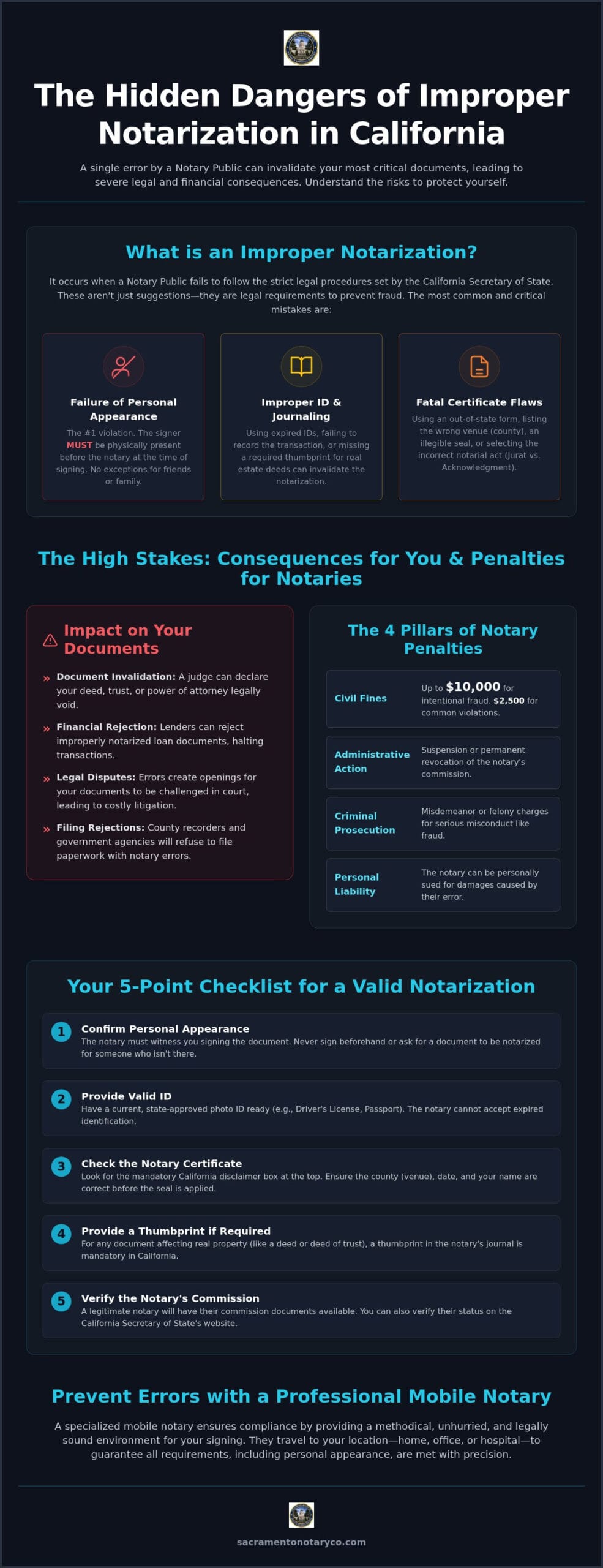
A Signer’s Checklist: How to Spot Notary Errors Before They Happen
You are the final line of defense against the consequences of improper notarization in California. While a notary is responsible for their own compliance, you’re the one who suffers if a document is rejected. Taking a few moments to observe the process can save you months of legal headaches. Start by verifying that the notary has a current commission through the California Secretary of State’s website. A professional won’t be offended if you ask to see their commission certificate or verify their status in the state database.
A legitimate signing begins with a request for identification. If a notary doesn’t ask for your valid, unexpired ID, they’re skipping a fundamental legal step. California law is strict about identity verification; relying on “personal knowledge” without recording ID details is a violation that puts your document at risk. You should also watch for the maximum fee. As of 2026, California notaries can charge no more than $15 per signature for the act itself, though travel fees for mobile services are separate and should be agreed upon upfront.
What to Look for on the Document
Before the notary leaves, review the completed certificate. Every California acknowledgment or jurat must contain the mandatory disclaimer box at the top. This box states that the notary only verifies the identity of the signer and not the truthfulness of the document. If this box is missing, the document is non-compliant and will likely be rejected. Check these specific visual elements:
- The Venue: Ensure it lists the county where you’re currently standing (e.g., “County of Sacramento”), not where the notary’s office is located.
- The Date: It must be the actual day of the signing. Backdating or forward-dating is illegal and invalidates the act.
- The Seal: The stamp must be clear and legible. If it overlaps your signature or any text on the document, it may be rejected by a county recorder.
The Journal Entry Requirement
Every professional notary must maintain a sequential journal. You should insist on signing this journal and providing a thumbprint if the document involves real property, such as a deed or a deed of trust. Failing to obtain a required thumbprint can result in a civil penalty of up to $2,500 for the notary. This journal entry is your best defense if the authenticity of your signature is ever challenged in court. It provides a timestamped, witnessed record of the event that’s much harder to dispute than a standalone piece of paper.
If you want to ensure your high-stakes documents are handled with this level of scrutiny, it’s essential to book a professional mobile notary who follows every step of the state’s checklist. This proactive approach prevents errors before they become permanent records.
Preventing Errors with Professional Mobile Notary Services
Choosing the right environment for your signing is just as important as the document itself. Many people default to retail shipping centers or banks, but these settings are often loud, rushed, and prone to distractions. If a clerk is trying to manage a long line of customers while handling your paperwork, they’re much more likely to miss a technical requirement. These small oversights are what lead to the consequences of improper notarization in California, such as rejected deeds or invalid powers of attorney. Using professional mobile notary services allows you to review your documents in a quiet, controlled setting, significantly reducing the risk of human error.
Specialized loan signing agents are particularly critical when dealing with mortgage paperwork. Real estate transactions involve hundreds of pages, and a single missed initial can cause a lender to halt funding or cause a rate lock to expire. Unlike a general retail clerk, a specialized agent understands the specific requirements of lenders and title companies. They act as a final quality control check, ensuring that every signature is captured and every seal is placed correctly before the documents are sent back to escrow. This accountability is what separates a local specialist from an anonymous retail employee.
Sacramento Notary Co’s Approach to Accuracy
At Sacramento Notary Co, we prioritize procedural accuracy through a methodical double-verification process. We review every certificate’s wording before leaving the site to ensure it meets current 2026 standards. Our team has extensive experience with the specific filing requirements of the Sacramento County Recorder, which helps prevent “Cloud on Title” issues for local homeowners. We also specialize in high-stakes environments, such as hospital bedside and emergency signings. In these sensitive situations, stress levels are high, and the potential for error increases. We provide a calm, steady presence to ensure that even urgent medical directives are executed with total legal compliance.
Next Steps if You Suspect an Error
If you discover an error after a signing has concluded, you must act quickly to mitigate the consequences of improper notarization in California. You can’t simply “fix” an old certificate; a professional must perform a corrective notarization. This involves re-executing the document or attaching a fresh, compliant certificate during a new personal appearance. If you suspect a notary has engaged in willful misconduct or fraud, you can file a formal complaint with the Secretary of State in Sacramento. This office investigates compliance violations and has the authority to suspend or revoke commissions. To ensure your paperwork is handled correctly the first time, Schedule a reliable mobile notary session today and speak with a professional who values accuracy as much as you do.
Protecting Your Legal Interests with Precision
Your legal and financial security depends on the integrity of your notarized documents. We’ve explored how even a minor procedural error can lead to the severe consequences of improper notarization in California, including document invalidation and significant financial loss. By verifying a notary’s commission and insisting on a proper journal entry, you take an essential step toward ensuring your contracts remain ironclad. It’s often the small details, like the mandatory California disclaimer box or a clear seal, that make the difference between a successful filing and a costly legal delay.
If you’re dealing with high-stakes paperwork, you deserve a partner who prioritizes accuracy and local compliance. Sacramento Notary Co provides a calm, reliable service designed to lower your stress during complex situations. Whether you need an emergency hospital bedside signing or expertise in Sacramento County real estate standards, we’re here to help. You can Book a Reliable Sacramento Mobile Notary Now to secure your documents with confidence. Taking this proactive step ensures your final wishes and property rights are fully protected.
Frequently Asked Questions
Can an improper notarization make a contract void?
Yes, an improper notarization can lead a court to declare a contract void or unenforceable. While the notary doesn’t validate the contract’s terms, the seal provides a “presumption of authenticity.” If that seal is found to be invalid due to procedural errors, the document loses its legal standing. This often results in the entire agreement being set aside during litigation or probate proceedings, leaving your interests unprotected.
What is the most common notary mistake in California?
The most frequent error is the failure to require the personal appearance of the signer. Many notaries mistakenly perform “favors” for friends or family by signing documents without the individual present. Other frequent issues include using outdated certificates or missing the mandatory California disclaimer box. These errors are the primary drivers behind the consequences of improper notarization in California, leading to immediate rejection by state agencies.
Can I sue a notary for a mistake they made on my document?
You can file a civil lawsuit against a notary if their error caused you actual financial loss. Notaries are personally liable for damages resulting from their negligence or misconduct. If a rejected deed causes you to lose a property sale or an interest rate lock, you may seek restitution in court. Most professionals carry insurance, but that doesn’t prevent you from pursuing a claim for the full amount of your damages.
How much can a California notary be fined for an error?
Under Government Code 8214.15, fines vary based on the severity of the act. Negligent errors typically result in a $750 penalty, while willful misconduct carries a $1,500 fine. The state imposes much steeper penalties for specific violations; for example, failing to obtain a required thumbprint in a journal can cost $2,500. Serious offenses, such as intentional falsification of a certificate or identity violations, can result in civil penalties reaching $10,000.
Does a notary error automatically mean fraud was committed?
No, a mistake doesn’t always indicate fraud. California law distinguishes between negligence, which involves honest errors like typos or illegible seals, and willful misconduct. Fraud requires a specific intent to deceive or falsify records. While both types of errors can trigger the consequences of improper notarization in California, only deliberate acts lead to criminal prosecution. However, even simple negligence can result in the permanent revocation of a notary’s commission.
What should I do if my document was rejected due to a notary error?
You must arrange for a new notarization immediately to fix the problem. California law doesn’t allow a notary to simply edit or “fix” an old certificate after the signing is complete. The signer must appear again before a notary to execute a fresh, compliant certificate. If you’re facing a deadline, it’s best to contact a mobile notary who can travel to your location and ensure the new paperwork meets all current 2026 standards.
Can a notary correct a mistake after the signing is over?
A notary cannot legally alter a certificate once the signing session has ended. Any changes made to a document after the signer has left are considered improper and could be viewed as fraudulent. The only authorized way to correct an error is to perform a completely new notarial act. This process requires a new personal appearance, a new journal entry, and a new certificate reflecting the actual date the correction took place.
Are employers liable for notary errors made by their employees?
Employers are often held liable for mistakes made by their notary employees if the act occurred within the scope of employment. If a bank or retail clerk performs an improper notarization during their shift, the business can be sued for any resulting financial losses. Because of this high liability, many Sacramento businesses choose to refer clients to specialized mobile notary professionals who maintain their own insurance and have deep expertise in complex document requirements.