



Imagine sitting at your kitchen table with a stack of loan papers, only to realize a single clerical error just pushed your home funding back because you missed the Sacramento County 3:00 p.m. recording deadline. Securing expert mortgage document notarization Sacramento homeowners can trust is the best way to prevent these costly delays. It’s a common fear for many residents, and the pressure of a ticking clock only adds to the stress of a real estate closing. You deserve a process that’s handled with precision so you can focus on your move rather than worrying about paperwork rejection.
We understand that finding a convenient time for a signing shouldn’t feel like a second job. If you’re feeling confused about which specific forms require a seal or how to coordinate with your title company, you aren’t alone. This guide provides a clear path forward to help you ensure your closing is both accurate and stress-free. By utilizing a mobile notary who understands local requirements, you can secure your investment without the typical logistical headaches or travel requirements.
In the following sections, we’ll outline the critical documents that need verification, how mobile services fit into your busy schedule, and what you need to have ready to ensure a flawless signing experience from start to finish.
Key Takeaways
- Understand the critical difference between a standard notary and a Certified Loan Signing Agent who specializes in navigating complex loan packets.
- Identify the essential documents in your signing packet, such as the Deed of Trust and Promissory Note, to avoid last-minute confusion during closing.
- Learn how professional mortgage document notarization Sacramento services ensure your paperwork meets strict county recording standards to prevent funding delays.
- Prepare for your appointment by verifying current California identification requirements and reviewing your documents in advance for potential questions.
- Discover how mobile notary services can streamline your real estate transaction by meeting at your preferred location to fit your busy schedule.
Understanding Mortgage Document Notarization in Sacramento
Mortgage document notarization Sacramento residents require is more than just a formal stamp on a page. It’s the official verification of signatures on loan documents by a commissioned Notary Public. This process serves as a vital safeguard against fraud, ensuring that the people signing the deed of trust are who they claim to be. Without this verification, documents aren’t legally binding and won’t be accepted for official recording by the county.
In our local market, the Sacramento County Clerk/Recorder’s office plays a pivotal role. They require all real estate documents to meet specific standards before they’re entered into the public record. If you submit documents before 3:00 p.m. on a business day, they’re typically recorded the same day. If you miss that window, your recording and your funding often slide to the next business day. Professional mortgage document notarization Sacramento services ensure your paperwork is ready for immediate acceptance, avoiding the $20 penalty for missing a Preliminary Change of Ownership Report or other clerical rejections.
The Critical Link Between Signing and Funding
Lenders operate on strict timelines and won’t release funds until every signature is verified and every certificate is error-free. Even a minor typo on a notary certificate can stop a multi-million dollar transaction in its tracks. Professional mortgage document notarization Sacramento experts prevent these common funding delays by double-checking every initial and seal before leaving the table. A mobile notary specialized in loan signings facilitates a faster turnaround for title companies by traveling directly to your home or office. This speed is essential in Sacramento’s competitive housing market, where delays can lead to missed closing dates or per-diem interest charges.
California Notary Laws and Real Estate
California has some of the strictest notary laws in the nation. For real estate transactions, the notary must maintain a detailed journal entry for every deed of trust or document affecting real property. This entry includes a thumbprint from the signer, providing an extra layer of security. These rules are designed to protect you, but they also mean your notary must be highly organized and methodical to ensure compliance with California Secretary of State mandates.
When you meet with a notary, you must present valid, government-issued photo identification. The ID must be current or issued within the last five years. Accepted forms include:
- California Driver’s License or ID card
- U.S. Passport
- Foreign Passport stamped by U.S. Citizenship and Immigration Services
- Other U.S. state-issued driver’s licenses
Key Documents in Your Mortgage Signing Packet
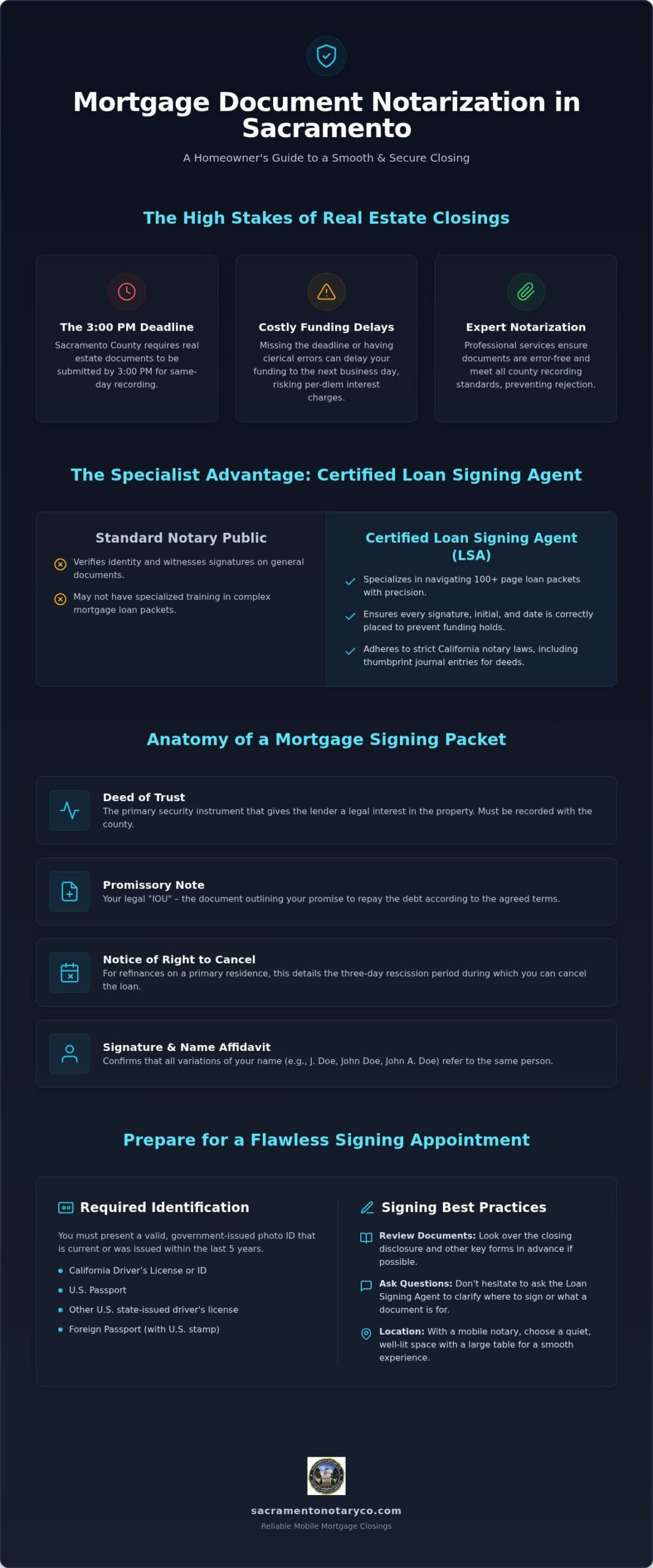
A typical loan packet is a daunting stack of paper, often exceeding 100 pages. While many of these forms are simple disclosures, several critical pages require your signature to be officially witnessed. Professional mortgage document notarization Sacramento ensures these specific pages meet legal standards so your loan closes on time. Understanding which documents require a seal helps you stay organized and reduces the stress of the signing appointment.
- The Deed of Trust: This is your primary security instrument. It’s the document that gives the lender a legal interest in the property.
- Promissory Note: This is your legal “IOU.” While it often doesn’t require a notary seal, it’s the most important financial document in the set because it outlines your promise to repay the debt.
- Notice of Right to Cancel: If you’re refinancing your primary residence, you’ll see this form. It details the three-day rescission period during which you can cancel the loan.
- Signature Name Affidavit: This form confirms that all variations of your name found in your credit history or on the title refer to the same person.
The Deed of Trust and Property Transfers
The Deed of Trust is the most significant document in your packet because it must be recorded with the Sacramento County Clerk/Recorder to be effective. Because this document establishes the lender’s lien on the property, the notary’s role is to verify the grantor’s signature with absolute certainty. Mistakes here can lead to the county rejecting the filing, which stops your loan from funding. You can learn more about this specific process in our guide to deed notarization Sacramento.
Financial Disclosures and Affidavits
Beyond the primary loan documents, you’ll sign several affidavits. As mandated by the California Secretary of State, every signature on these high-stakes documents must be verified using specific identification protocols. The Occupancy Affidavit, for example, requires you to swear that the property will be your primary residence. This often involves a Jurat, where the notary administers an oath, rather than a simple Acknowledgment. Your Closing Disclosure (CD) also appears here, providing the final breakdown of your loan terms and closing costs. If you want to ensure every page is initialed and signed correctly, consider booking a mobile loan signing service to come directly to you.
Why a Certified Loan Signing Agent (LSA) Matters
While any commissioned notary can technically witness a signature, a Certified Loan Signing Agent possesses specialized training tailored specifically to the mortgage industry. A general notary often handles single-page documents like travel consents or simple affidavits. In contrast, an LSA manages the entire closing process with a deep understanding of the paperwork involved. They recognize the requirements of lenders and title companies, ensuring that every initial is placed and every date is accurate. This expertise is vital because mortgage document notarization Sacramento signings involve high-stakes financial commitments where there’s no room for procedural error.
Navigating Complex Loan Packets
Every loan type carries its own set of rules. A VA loan packet looks different than an FHA or Conventional loan, and an experienced agent knows exactly where the common pitfalls lie. For example, they’ll verify that the primary borrower hasn’t missed a signature on a specific lender disclosure that could trigger a “re-sign.” Re-signing documents isn’t just an inconvenience; it can cost you hundreds of dollars in extended rate lock fees or delayed moving costs. By identifying missing signatures before leaving your table, a professional agent protects your timeline and your budget.
Professionalism in the Sacramento Real Estate Market
Sacramento’s real estate market moves at a brisk pace. When a home is scheduled to close, the handoff between the notary, title company, and escrow officer must be seamless. Punctuality and procedural accuracy aren’t just goals; they’re requirements for a successful transaction. We provide a sense of calm reliability during these high-pressure moments, acting as a steady guide through the final steps of your home purchase or refinance. Our focus is on making a necessary task as frictionless as possible for you.
Choosing the right service also means considering security and convenience. While some states allow digital options, understanding the benefits of mobile notary vs. remote online notary in Sacramento is vital for protecting your sensitive data. A mobile LSA provides the security of an in-person meeting, which remains the current legal standard for high-value real estate transactions in California. This face-to-face verification ensures that the mortgage document notarization Sacramento homeowners receive is both legally sound and personally tailored to their specific needs.
Preparing for Your Sacramento Home Closing Appointment
Preparation is the foundation of a successful closing. When you arrange for mortgage document notarization Sacramento homeowners often find that a small amount of legwork beforehand prevents major headaches at the signing table. Your loan signing agent is there to guide you through the paperwork, but your readiness ensures the appointment stays on track and meets the strict deadlines set by your lender and the county recorder.
Before the notary arrives, you should review your digital closing disclosure to flag any questions regarding your interest rate, monthly payment, or closing costs. While your notary can identify where you need to sign, they cannot provide legal advice or explain the financial intricacies of your loan. Having these answers from your lender ahead of time keeps the momentum of the signing moving forward. Additionally, ensure that all parties listed on the loan are present and that any required funds for closing are already coordinated with your escrow officer.
Identification Requirements in California
California law requires strict identity verification for every signer. You must present a valid, government-issued photo identification that contains a serial number, a photograph, and a physical description. Acceptable forms of ID include:
- California Driver’s License or ID card
- U.S. Passport or Passport Card
- Foreign Passport stamped by U.S. Citizenship and Immigration Services
- U.S. Military ID card
In California, the identification provided must be current or issued within the last five years to be legally acceptable for notarization. If a signer doesn’t have a valid ID, we can sometimes use two credible witnesses who personally know the signer and possess their own valid identification. This process requires advance notice to ensure all legal criteria are met before the signing begins.
Setting the Stage for an Efficient Signing
The environment where you sign matters just as much as the documents themselves. A clear kitchen table or a large desk provides the necessary space for the agent to organize the extensive loan packet and for you to sign comfortably. Good lighting is essential, as many mortgage documents contain small print that must be read carefully before initialing. You should also try to manage potential distractions, such as pets or phone calls, to ensure every signature is captured correctly the first time.
A typical mortgage document notarization Sacramento session lasts between 45 and 60 minutes. This timeframe allows for a methodical review of the documents without feeling rushed. If you’re ready to secure your closing date, you can book our professional mobile loan signing service to meet you at a location that fits your busy schedule. By creating a quiet, well-lit space, you help ensure a smooth and error-free experience that leads directly to your loan funding.
Sacramento Notary Co: Reliable Mobile Mortgage Closings
Sacramento Notary Co specializes in high-stakes financial document verification with a focus on procedural accuracy. We understand that your home closing represents a major life milestone and a significant financial commitment. This is why our commitment to professional transparency and punctuality is at the center of every appointment we attend. We don’t just witness signatures; we act as the final checkpoint to ensure your paperwork is complete and ready for the county recorder’s office.
Our mobile service is designed to fit into your busy life. We travel throughout the entire Sacramento metropolitan area, bringing our expertise directly to your home, office, or even a local coffee shop. By choosing a mobile loan signing service, you eliminate the stress of navigating traffic or taking time off work to find a stationary notary office. Our goal is to make the mortgage document notarization Sacramento residents require as frictionless and convenient as possible.
A Steady Guide for Your Real Estate Journey
The closing process can feel overwhelming, especially when faced with a massive stack of legal disclosures. We function as a steady guide during these complex moments, helping to lower borrower stress through clear instructions and a reassuring, calm demeanor. We’ve built strong relationships with local Sacramento title and escrow partners over the years, which allows us to understand their specific preferences for document organization and return shipping. This deep local knowledge ensures that once we leave your table, the rest of the process moves forward without a hitch.
Scheduling is handled on your terms. We recognize that real estate transactions often involve tight deadlines and last-minute changes from lenders. We remain flexible and responsive to these shifts, ensuring that your signing happens exactly when it needs to. This reliability is what sets us apart as a trusted partner for homeowners across the region. If you’re managing a complex schedule, our punctuality ensures your day stays on track.
Get Started with Your Sacramento Loan Signing
Booking your appointment is a straightforward process designed to give you immediate peace of mind. If you’re ready to move forward, simply reach out to coordinate a time and location that works for all parties involved. In sensitive situations where a signer may be indisposed, we also offer specialized hospital notary fees Sacramento for professional bedside services. This ensures that even in unexpected circumstances, your property transfer or refinance can proceed without delay. Your mortgage document notarization Sacramento experience should be the easiest part of your home-buying journey. Contact us today to secure an expert mobile notary and ensure a smooth, error-free closing.
Secure Your Home Investment with Professional Notarization
Navigating a real estate closing requires more than just a pen and a few signatures. It’s about ensuring every document, from the Deed of Trust to the Signature Name Affidavit, meets strict county standards. By choosing a specialist who understands the nuances of mortgage document notarization Sacramento homeowners can avoid the stress of funding delays and clerical errors. We’ve explored how specialized training and proper preparation turn a daunting stack of paperwork into a manageable, successful transaction.
Preparation remains your best tool for success. When you have your valid identification ready and a quiet environment prepared, the process becomes a seamless final step in your property journey. Our certified loan signing experts are committed to providing a punctual and error-free guarantee through our mobile service across Sacramento. We’re here to act as your steady guide, ensuring your high-stakes paperwork is handled with the precision it deserves. If you’re ready to finalize your transaction, it’s time to partner with a professional who values your time as much as you do.
Book Your Professional Mortgage Notarization with Sacramento Notary Co Today
Your new home or refinance is within reach, and we’re ready to help you cross the finish line with confidence and ease.
Frequently Asked Questions
What is the difference between a notary public and a loan signing agent?
A loan signing agent is a notary with specialized training to handle complex real estate files. While a standard notary focuses on general documents like affidavits or power of attorney forms, a signing agent understands the specific requirements of lenders and title companies. They know exactly where signatures and initials are required within a 100-page loan packet, which helps ensure the transaction is legally binding and ready for county recording.
Does California allow remote online notarization for mortgage documents?
Currently, California notaries aren’t authorized to perform remote online notarizations. Although the Online Notarization Act was signed into law, it won’t be implemented until the Secretary of State develops the necessary technology, which may not occur until 2030. This means every mortgage document notarization Sacramento homeowners schedule must be conducted in person. A mobile notary provides the necessary convenience by traveling to your location to perform this required physical verification.
What forms of ID are required for a real estate closing in Sacramento?
You must present a valid, government-issued photo identification that includes a serial number, a photograph, and a physical description. The most common forms include a California Driver’s License, a U.S. Passport, or a military ID card. California law requires these documents to be current or issued within the last five years. If you don’t have a valid ID, you may need to provide two credible witnesses who personally know you and possess their own identification.
Can a mobile notary explain the terms of my loan to me?
A mobile notary functions as an impartial witness and cannot provide legal advice or explain the financial terms of your loan. Their primary duty is to verify your identity and ensure the documents are signed voluntarily. If you have questions about your interest rate, loan duration, or specific fees, you should address those with your lender or escrow officer. It’s best to resolve these concerns before the notary arrives to ensure a smooth session.
How much does a mobile notary charge for a mortgage signing in Sacramento?
Costs for a mobile signing depend on the type of loan package and the travel required to reach your location. Single document notarizations differ from full loan sets like refinances, reverse mortgages, or buyer packages. Since these sessions require more time and specialized knowledge, the fees reflect the professional expertise involved. You should always request a clear breakdown of travel and service fees from your provider before confirming your appointment to ensure professional transparency.
What happens if I find a mistake in my documents during the signing?
If you spot an error in your paperwork, you must contact your loan officer or title company immediately. The notary cannot change the document text or authorize corrections without direct approval from the lender. In some cases, the lender will allow you to line through the error and initial the change. In other situations, they may need to send updated digital files to the mortgage document notarization Sacramento specialist for a new printing.
Do I need a witness for my mortgage document notarization?
Most California real estate documents don’t require additional witnesses beyond the notary. However, certain out-of-state documents or specific lender requirements may necessitate one or two witnesses to be present. It’s important to check your closing instructions beforehand to see if witnesses are required. Since the notary is acting as an official witness, they generally cannot serve as a secondary witness on the same document, so you’ll need to arrange for disinterested parties.
How long does a typical mobile loan signing appointment take?
You should expect a typical mobile signing to take approximately 45 to 60 minutes. This timeframe allows the agent to verify your identification, complete the required journal entries, and guide you through the stack of paperwork methodically. If the loan involves multiple properties or several signers, the appointment may take longer. Having a well-lit, quiet space prepared and your identification ready helps ensure the process moves at a brisk, professional clip.