


Are you still worried about getting a “Red Ribbon” from the Philippine Consulate to make your California documents official? Since the Philippines joined the Hague Apostille Convention, that old process is gone, but many people still find themselves confused by the updated 2026 requirements. If you’re looking for an apostille for use in the Philippines Sacramento, you need to know that a single certificate from the California Secretary of State is now all it takes for legal recognition. It’s completely normal to feel some anxiety about whether a bank in Manila or the PSA will accept your paperwork, especially when family property or urgent business matters are on the line.
We understand that you don’t have hours to waste waiting in downtown Sacramento lines or the luxury of time to risk a document rejection. This guide explains exactly how to navigate the current system to ensure your California documents are 100% legally valid in the Philippines. We’ll walk you through the essential Special Power of Attorney (SPA) notarization process, current Secretary of State turnaround times, and the specific steps to make your documents “Apostille-ready” before you ever submit them for authentication.
Key Takeaways
- Understand why the Hague Convention transition means you no longer need a “Red Ribbon” from the Consulate for documents issued in California.
- Learn why flawless notarization is the essential first step when obtaining an apostille for use in the Philippines Sacramento for Special Power of Attorney forms.
- Identify the specific types of original certified vital records, such as birth or marriage certificates, that are eligible for immediate authentication.
- Get the latest 2026 updates on Secretary of State processing times to ensure your documents are ready for urgent property or banking needs.
- Discover how to use mobile notary services to verify your paperwork at home or the office, preventing costly rejections at the state level.
Understanding the Apostille for Use in the Philippines (Sacramento 2026)
An Apostille is a specialized certificate that authenticates the signature, seal, and position of the California public official who signed your document. It doesn’t certify the content of the document itself. Instead, it proves to foreign authorities that the official’s signature is genuine. If you’re preparing an apostille for use in the Philippines Sacramento, this certificate is the only way to ensure your California-issued paperwork is legally recognized by Philippine government agencies, banks, or schools.
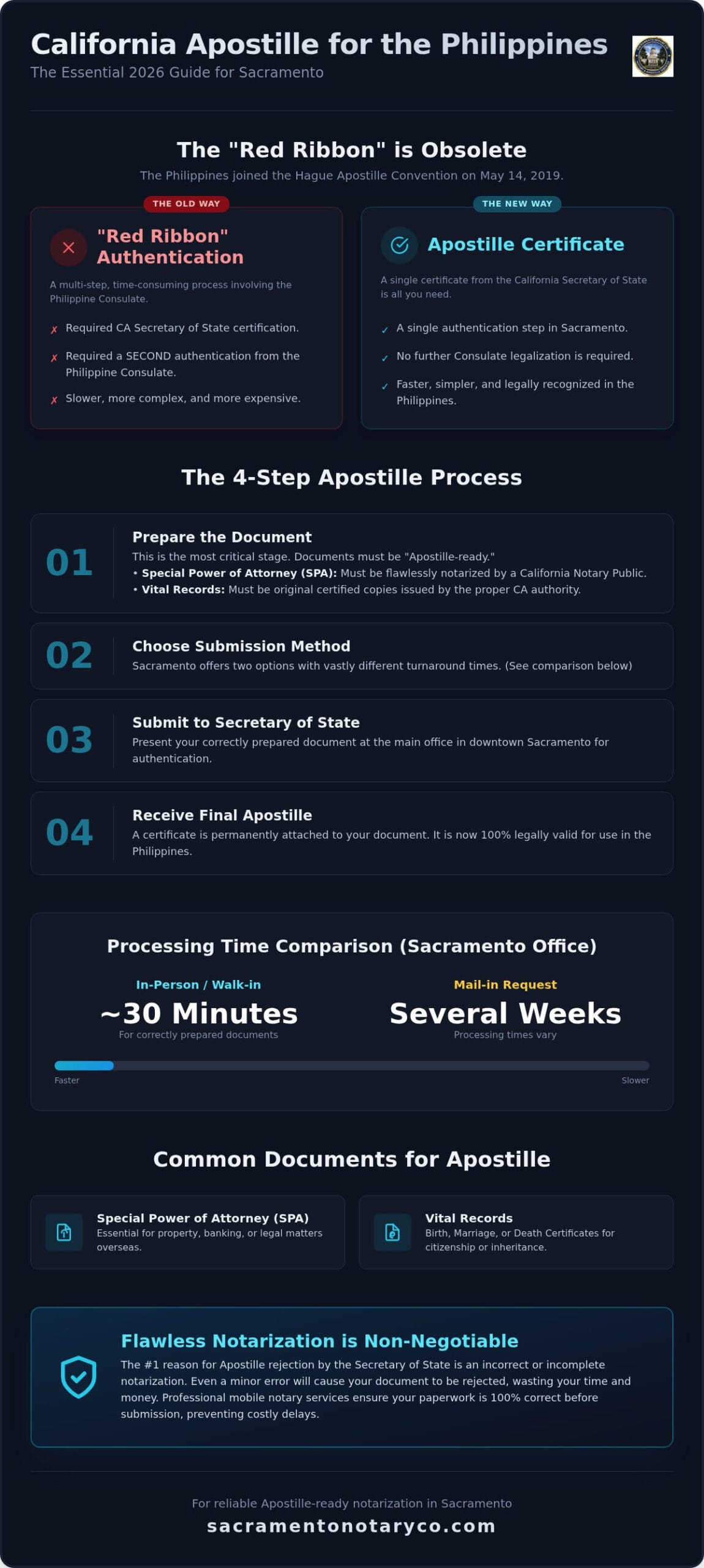
The process changed significantly on May 14, 2019, when the Philippines officially joined the Apostille Convention. This international treaty simplified the way documents move between countries. Before this shift, the process was much more tedious. Now, a single Apostille from the California Secretary of State is all you need for your documents to be valid across the archipelago. Sacramento’s role is central to this process because it’s home to the primary Secretary of State office, making it the most efficient location for authentication in the state.
The End of the ‘Red Ribbon’ Era
For decades, the “Red Ribbon” was the gold standard for document authentication at the Philippine Consulate. This involved a physical red ribbon and a gold seal applied by consular officers. Since the 2019 treaty took effect, the Philippine Consulate General in San Francisco no longer issues these ribbons for California documents. The Apostille has completely replaced that old system.
Confusion still happens. You might find that a local bank branch in a smaller Philippine province or a specific government clerk still asks for a Red Ribbon. If this occurs, it’s usually because they haven’t updated their internal manuals. You can explain that the Philippines is now an Apostille country. The certificate you receive in Sacramento is the final legal step; it doesn’t require any further stamps from the Consulate to be valid.
Why Sacramento is the Best Place for Processing
Sacramento is the most logical place to handle your paperwork because the Secretary of State’s main office is located right in the downtown area. While there’s a regional office in Los Angeles, the Sacramento headquarters is the heart of the state’s authentication services. Local residents have a distinct advantage. You can choose between mail-in requests or in-person “walk-in” services.
As of August 2026, the Secretary of State is processing mail-in requests received earlier in the month, which can take several weeks to return. In-person submissions are typically processed within 30 minutes if you arrive before the 4:30 p.m. cutoff. Sacramento Notary Co helps you capitalize on this local advantage. We ensure your documents are “Apostille-ready” by providing flawless notarization first. This prevents the frustration of waiting in line only to have a clerk reject your document due to a minor notary error. We bridge the gap between your signature and the state’s final seal of approval.
Common Documents Requiring a Philippines Apostille
When you are preparing an apostille for use in the Philippines Sacramento, the specific type of document you have determines your very first step. Most requests we see fall into four main categories: personal legal authorizations, vital records, sworn affidavits, and corporate filings. Each has its own set of rules for authentication and verification.
Notarizing the Special Power of Attorney (SPA)
The Special Power of Attorney (SPA) is the most common document sent from California to the Philippines. It’s essential for selling property, managing bank accounts, or handling legal matters without traveling overseas. Philippine institutions, such as the Registry of Deeds or major banks like BDO and BPI, are incredibly strict about document formatting. If your SPA is not notarized according to California’s exact standards, the Secretary of State will reject your apostille application immediately.
This is where the process often fails for many residents. Using a reliable mobile notary Sacramento ensures that the initial signing is flawless. We come to your home or office to verify your identity and witness the signature, ensuring the notary block meets the latest 2026 state requirements. This preparation makes the subsequent apostille step a formality rather than a gamble.
Apostille for Vital Records
California birth, marriage, and death certificates are frequently required for dual citizenship applications or inheritance claims in the Philippines. Unlike private contracts, you can’t notarize a copy of a birth certificate yourself. The California Secretary of State only issues an apostille for original certified copies. These must be issued by the County Clerk-Recorder or the State Registrar.
The state maintains a database of signatures for these public officials. If the official who signed your certificate is no longer in their role or their signature isn’t on file, you’ll need to obtain a new certified copy. This is a common hurdle for older documents. Always check that your certificate was issued by the county or state, not a local health department, as many health department signatures aren’t eligible for an apostille.
Other documents like an “Affidavit of Support and Guarantee” or a business document apostille Sacramento follow similar paths. Business filings, such as Articles of Incorporation, must be certified by the state before the apostille can be attached. Managing these rules is simpler when you have a clear plan for your apostille for use in the Philippines Sacramento. If you’re feeling overwhelmed by these technical requirements, reaching out for local guidance can help you get it right the first time.
The 4-Step Apostille Process in Sacramento
Securing an apostille for use in the Philippines Sacramento requires following a methodical four-step sequence. If you miss a single detail in the preparation phase, the state office will likely reject your application during the submission phase. This process moves from document acquisition and notarization to state authentication and, finally, international transmittal.
Step 1 & 2: Preparing Your Document for Success
Your first task is ensuring you have the correct version of your document. For vital records, this means an original certified copy from the county or state. For private documents like a Special Power of Attorney (SPA), it requires a professional notarization. The notary must attach a proper California Acknowledgment or Jurat form. If the notary uses outdated wording or fails to list the correct venue, the Secretary of State cannot verify the signature.
Common errors often lead to immediate rejection. These include expired notary commissions, missing seals, or even signatures that don’t match the state’s records. This is particularly critical when dealing with property matters for elderly family members who may need a mobile notary to visit their home or a hospital bedside. A professional mobile notary acts as your primary safeguard against these procedural rejections by ensuring every legal seal and signature meets current 2026 standards before you leave your house.
Step 3: Navigating the Secretary of State Office
Once your document is prepared, it must be submitted to the California Secretary of State office. The physical headquarters is located at 1500 11th Street, Sacramento, CA 95814. You have two primary options for submission: mail-in or in-person. As of August 2026, the Sacramento office is processing mail-in requests received on August 3. This means mail-in clients should expect a wait of several weeks for their documents to return.
In-person submissions are much faster. They are typically processed within 30 minutes. However, you must arrive by 4:30 p.m. to ensure same-day service. While faster, this option requires you to navigate downtown parking and wait in security lines. The fee is $20.00 per apostille, plus a $6.00 special handling fee for each signature being authenticated in person. Many residents choose facilitation services to handle this delivery, avoiding the logistical headache of the downtown office entirely.
Step 4: Transmittal to the Philippines
Finally, once the Secretary of State attaches the apostille certificate, your document is legally authenticated for international use. You no longer need to worry about additional steps at the consulate. The Philippine Consulate General confirms that documents with a California apostille are ready for immediate use without further consular legalization. You can now securely send your 100% valid document to its final destination in the Philippines via a trusted international courier.
Apostille vs. Embassy Legalization: What You Need to Know
If you’ve been handling international documents for years, you likely remember the “Red Ribbon” process. You had to visit the Secretary of State first and then make a second trip to the Philippine Consulate General in San Francisco. This two-step process, known as embassy legalization, is no longer required for California documents. Since the Philippines joined the Hague Convention, obtaining an apostille for use in the Philippines Sacramento has become a one-step procedure. Once the Secretary of State issues the certificate, your document is legally ready for use in any Philippine province.
The Philippine Consulate in San Francisco is no longer the primary stop for Sacramento residents. In fact, they’ll often direct you back to the Secretary of State if you haven’t obtained your apostille first. This shift has significantly lowered the administrative burden for everyone involved. You don’t have to worry about scheduling multiple appointments or paying separate legalization fees to the Philippine government. One seal from Sacramento is all it takes.
Why the Red Ribbon Disappeared
The transition happened on May 14, 2019, when the Philippines officially acceded to the Apostille Convention. This change was designed to simplify life for Filipino expats and those conducting business abroad. The most immediate benefit is faster processing. You don’t have to wait for consular appointments or mail documents back and forth between multiple agencies.
For those worried about security, the new system is actually more transparent. Most modern apostilles include a QR code or a serial number. If a bank in Manila or a government agency in Cebu questions the document’s validity, they can verify it online through the California Secretary of State’s e-registry. This digital verification replaces the old physical ribbon and gold seal, providing a more secure and verifiable trail for your high-stakes paperwork.
Dealing with Outdated Requirements
Even though the law changed in 2019, you might still encounter a lawyer or bank clerk in the Philippines who insists on a “Red Ribbon.” This is usually due to outdated internal manuals. If this happens, you don’t need to panic or return to the consulate. Most issues are resolved by providing a copy of the Philippine Department of Foreign Affairs (DFA) circular that explains the Apostille’s validity. These rare exceptions are becoming less common as local agencies catch up to international standards.
Success in the Philippines depends entirely on the quality of your Sacramento start. If your document is rejected, it’s rarely because of the Apostille itself; it’s usually because the underlying notarization was flawed. We focus on providing “Apostille-ready” documentation from the very beginning. We ensure that every seal and signature meets the specific standards that both the California Secretary of State and Philippine agencies expect. If you’re ready to ensure your documents are prepared correctly for your family or business matters, you can book a reliable mobile notary Sacramento to get started today.
Why Use Sacramento Notary Co for Your Philippines Apostille?
Choosing a local specialist for your apostille for use in the Philippines Sacramento ensures your legal matters don’t stall due to procedural errors. We focus on the most critical part of the journey: making sure your document is “Apostille-ready” before it ever reaches the Secretary of State’s desk. While the state office handles the final authentication, we handle the preparation that prevents rejection. Our team understands the specific nuances of California’s notarization standards and how they intersect with Philippine legal requirements.
We act as your expert guide, providing a steady hand during complex or time-sensitive situations. If you’re dealing with a Special Power of Attorney (SPA) for a property sale in Manila or a bank transaction in Quezon City, you can’t afford a mistake. We verify that every seal is clear, every signature is witnessed correctly, and every notary block matches current 2026 statutes. This methodical approach saves you from the frustration of multiple trips to downtown Sacramento or the uncertainty of mail-in delays.
Mobile Notary Services Across Sacramento
Our mobile notary services are designed for maximum convenience, serving clients in Sacramento, Elk Grove, Roseville, and Folsom. We bring professional signing services directly to your home or office, which is ideal for busy professionals or those with limited mobility. If you’re managing an urgent family matter, we also offer hospital bedside in Sacramento to ensure that SPAs or health-related documents are signed and notarized without delay. This supportive, local presence makes a complex legal task feel manageable and frictionless.
Ready to Start Your Philippines Apostille?
Getting started is simple. When you book an appointment with Sacramento Notary Co, we provide a clear, upfront quote for our mobile notary and facilitation services. To ensure a smooth session, please have the following ready:
- A valid, unexpired government-issued photo ID for all signers.
- The complete document you need notarized (such as your SPA or Affidavit).
- Any required witnesses as specified by the document’s instructions.
If you’re unsure about the requirements for your specific paperwork, we’re here to help clarify the process. Contact us today to schedule your mobile visit and secure a document that is 100% legally valid for use in the Philippines. Our goal is to provide the punctuality and procedural accuracy you need for a successful outcome.
Secure Your Documents for the Philippines with Confidence
Navigating the updated 2026 requirements for an apostille for use in the Philippines Sacramento doesn’t have to be a stressful experience. You now understand that the old “Red Ribbon” system is obsolete and that a single certificate from the California Secretary of State is the final step for legal recognition. Whether you’re handling a property sale, a bank transaction, or a dual citizenship application, the foundation of a successful process is a flawless notarization that meets every state standard.
Sacramento Notary Co acts as your steady guide through these logistical hurdles. We are experts in Philippine SPA notarization and provide on-site mobile service at your convenience. If you’re facing a time-sensitive situation, we are specialized in hospital and emergency notarizations to ensure your paperwork moves forward without delay. By making your documents “Apostille-ready” from the start, we help you avoid the frustration of state rejections or international complications.
If you’re ready to move forward with your important family or business matters, we’re here to help. Book Your Mobile Notary for a Philippines Apostille Today and gain the peace of mind that comes with professional accuracy. We look forward to making this process as smooth as possible for you.
Frequently Asked Questions
Is an Apostille the same as a Red Ribbon for the Philippines?
Yes, it serves the same legal purpose. Since the Philippines joined the Hague Convention in 2019, the Apostille replaced the old Red Ribbon system. It authenticates your document for use in the Philippines without needing further consulate stamps. It’s now the standard for anyone seeking an apostille for use in the Philippines Sacramento. While the appearance changed, its legal standing is identical to the previous ribbon and gold seal.
How long does it take to get an Apostille in Sacramento in 2026?
Your wait time depends entirely on the submission method you choose. If you visit the Secretary of State office on 11th Street in person, you can often receive your certificate in about 30 minutes. If you choose to mail your request, the current processing time as of August 2026 is approximately three weeks. We recommend in-person submission for urgent family or business matters to avoid unpredictable mail delays.
Can a Sacramento notary apostille my birth certificate?
No, only the Secretary of State can issue an Apostille. Furthermore, a notary cannot notarize a birth certificate. You must provide an original certified copy issued by the County Clerk-Recorder or the State Registrar. If you have a hospital-issued certificate or a photocopy, the state will reject it. Ensure your certificate is an official government-issued document before attempting to obtain an apostille for use in the Philippines Sacramento.
Do I need to go to the Philippine Consulate in San Francisco if I have an Apostille?
No, you don’t need to visit the consulate at all. Once the California Secretary of State attaches the Apostille, your document is legally valid for use in the Philippines. The Hague Convention eliminated the need for “consularization” or embassy legalization. This one-step process saves you a trip to San Francisco and removes the additional fees previously associated with the Philippine Consulate’s authentication services.
How much does the California Secretary of State charge for an Apostille?
The standard fee is $20.00 for each Apostille certificate requested. If you choose to submit your documents in person at the Sacramento office, there is an additional $6.00 special handling fee for each public official’s signature being authenticated. You can pay by check, money order, or credit card for in-person services. Mail-in requests require a check or money order made payable to the Secretary of State.
Can I get an Apostille for a Philippines SPA on the same day in Sacramento?
Yes, same-day service is available for in-person submissions. If you arrive at the Secretary of State office before 4:30 p.m., they typically process the request within 30 minutes. However, the document must be properly notarized first. If the notary’s signature or seal is incorrect, you won’t get the Apostille that day. Using a specialized mobile notary ensures your Special Power of Attorney is perfect before you arrive.
What happens if my document is rejected by the Secretary of State?
If the state rejects your document, they will provide a rejection notice explaining the specific error. Common reasons include improper notary wording, an expired commission, or using a photocopy of a vital record. You’ll have to correct the mistake and pay the fees again for a new submission. We help prevent this by ensuring your notarization is flawless and your documents meet all state requirements before you submit them.
Does the Philippines accept digital or electronic Apostilles?
The Philippines generally requires a physical Apostille certificate attached to the original document. While California is exploring electronic options, the standard practice for international use remains the paper certificate with a physical signature and seal. Most Philippine banks and government agencies, such as the PSA, still expect a physical document. Always verify with the receiving agency in the Philippines if they have specific digital acceptance policies in 2026.